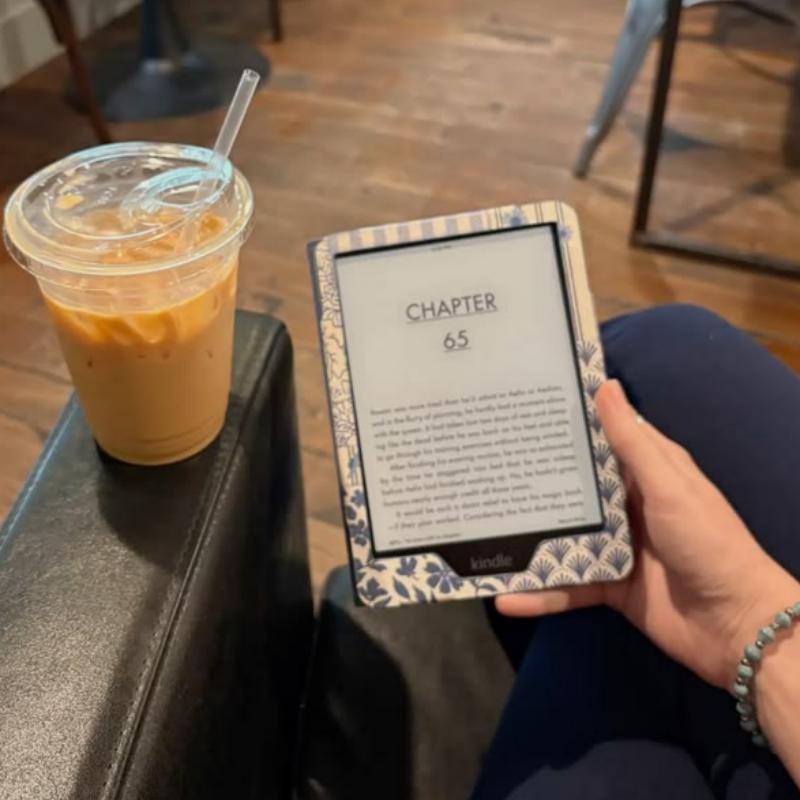
If you mostly read fiction on your Kindle, you can get away with a pretty simple setup: your Kindle, a charger, and maybe a cute case.
But nonfiction is a little different.
When I’m reading a novel, I can disappear into it for an hour without thinking about anything else. With nonfiction, I’m usually doing something more active. I’m underlining a sentence, going back to a previous chapter, looking up a word, taking a mental note, or stopping halfway through a page because I suddenly want to Google something.
And some nonfiction books are long.
Biographies, business books, psychology books, history, self-help, science, personal finance, memoirs, and academic books can turn into surprisingly long reading sessions. That’s when the little details of your Kindle setup start to matter.
A comfortable grip can make a difference. A stand can be useful when you’re reading at a desk. A good case protects your Kindle while making it easier to hold. Even something as simple as keeping your charging cable in the same place can make reading feel less annoying.
So if nonfiction makes up a big part of your Kindle library, here are the Kindle reading accessories I’d actually consider adding to your setup.
1. A Comfortable Kindle Case
A case is probably the most basic Kindle accessory, but for nonfiction readers, it’s also one of the most useful.
Nonfiction tends to involve longer reading sessions, especially when you’re reading a particularly interesting chapter. You might start reading at your desk and suddenly realize you’ve been holding your Kindle for 45 minutes.
A case gives your Kindle some extra protection, but the right one can also make the device easier to hold.
I personally like cases that don’t feel bulky. If the Kindle becomes noticeably heavier after adding a case, that kind of defeats the purpose of having such a lightweight e-reader.
Another thing worth considering is how you want your Kindle to work with other accessories.
For example, some newer Kindle cases have a magnetic surface across the back, allowing you to attach compatible accessories without needing to use a single fixed mounting point. That can be surprisingly convenient for nonfiction reading because you can change how you hold or position the Kindle depending on what you’re doing.
A fully magnetic Kindle case, such as the customizable designs available from GaNinno, is one example of this type of setup. Instead of treating the case as something you simply put on your Kindle and forget about, it can become the base for a more flexible reading setup.
For a nonfiction reader, that flexibility is actually pretty practical.
2. A Kindle Grip for Long Reading Sessions
If you read a lot of nonfiction, you probably already know that holding a Kindle for a long time can get tiring.
The Kindle itself is light, but your hand is still doing the same repetitive job: gripping the device and keeping it in a comfortable position.
A Kindle grip gives your fingers something more secure to hold onto.
This becomes especially useful when you’re reading one-handed. Maybe you’re lying on the couch, drinking coffee with your other hand, or reading while waiting somewhere. You don’t necessarily want to hold the Kindle tightly the entire time.
A magnetic grip can be particularly convenient if you already use a magnetic Kindle case.
The nice thing about a fully magnetic back is that the grip doesn't have to be permanently stuck in one specific location. You can move it depending on how you’re holding the Kindle.
If your hand position changes, your grip can change with it.
That sounds like a tiny detail, but after a long reading session, tiny details become noticeable.
3. A Magnetic Kindle Stand
This is one of those accessories I didn’t think I needed until I started reading more at a desk.
A Kindle stand is especially useful for nonfiction because nonfiction reading often happens alongside other activities.
Imagine reading a cookbook while cooking, going through a language-learning book while taking notes, or reading a business book while working at your computer.
You don’t always want to hold the Kindle in your hand.
A magnetic Kindle stand lets you position the screen in front of you while keeping both hands free.
You can also use one during study sessions. Put your Kindle next to your laptop or notebook, adjust the viewing angle, and use it almost like a second reading screen.
For people who read nonfiction on their lunch break or during short study sessions, this can make a surprisingly big difference.
The best part is that you don't need a huge desk setup. A small stand can sit beside your laptop, on a nightstand, or on a kitchen counter.
4. A Kindle Stand That Works Beyond Your Desk
One thing I like about flexible Kindle accessories is that they don’t have to be tied to one particular reading location.
Maybe your ideal reading spot changes throughout the day.
In the morning, you read at the kitchen table.
After work, you read on the couch.
Before bed, you read under the covers.
On the weekend, you take your Kindle outside.
Instead of buying a completely different setup for every situation, a magnetic case with compatible accessories can let you move between these situations more easily.
For example, a magnetic stand can be useful at a desk, while a magnetic grip makes more sense when you’re holding the Kindle in your hand.
That makes the case more like a foundation for your accessories rather than just a protective cover.
And for someone who reads different types of nonfiction in different environments, that kind of flexibility is nice.
5. A Kindle Sleeve for Travel
Even if your Kindle has a protective case, I still like having a sleeve when I’m traveling.
There’s a difference between protecting your Kindle while you’re using it and protecting it while it’s bouncing around inside your tote bag.
If you carry your Kindle with a laptop, water bottle, sunglasses, keys, chargers, and approximately 47 other things, a sleeve gives it a little extra separation.
It’s particularly useful for nonfiction readers because you may be carrying a Kindle specifically for work or study.
A simple sleeve doesn't need to be fancy. Look for something padded, lightweight, and easy to open.
You can also use a small pouch to keep your Kindle accessories together. That way, your grip, charging cable, and other little pieces aren’t randomly floating around the bottom of your bag.
6. A Good USB-C Charging Cable
Not exactly exciting, I know.
But a reliable charging cable is one of those Kindle accessories you notice most when you don't have one.
If your Kindle is part of your daily reading routine, keep a charging cable where you usually read.
I like having one near my bed and another at my desk. It saves the whole “where did I put my charger?” situation.
Most newer Kindle models use USB-C, but it’s still worth checking your specific model before buying a replacement cable.
You don’t need an expensive cable. Just choose one from a reputable manufacturer that is the correct type for your device.
7. A Portable Power Bank
A power bank makes sense if your nonfiction reading happens outside the house.
Think long flights, road trips, train rides, conferences, libraries, coffee shops, or travel days.
Kindles generally have excellent battery life, so you probably won’t need to charge constantly. But when you’re traveling, having a backup power source can be reassuring.
It also means you don't have to hunt for an outlet in an airport just because you decided to read for another two hours.
For nonfiction readers, this is particularly useful because long books can become travel companions. A 500-page biography might take you several weeks at home, but suddenly you’re reading 150 pages during a long flight.
8. A Kindle Accessory for Hands-Free Reading
Hands-free reading sounds a little lazy until you actually try it.
Then it becomes very hard to give up.
A stand is the obvious option, but there are other ways to make your Kindle easier to use without constantly gripping it.
You might position your Kindle on a stand while eating breakfast, place it beside your laptop while studying, or prop it up during a workout or stretching session.
This is especially useful for nonfiction that you’re reading alongside another activity.
For example, if you're following a language-learning book while practicing vocabulary, you can keep the Kindle upright and use your notebook at the same time.
The goal isn't necessarily to make reading completely hands-free.
It's simply about giving your hands a break when you don't need to hold the device.
9. A Customizable Kindle Case
Nonfiction readers aren't necessarily looking for a specific aesthetic, but I still think personalization is fun.
Your Kindle might contain everything from a book about ancient Rome to a memoir to a guide about investing. The case doesn't have to match all of that.
A customizable Kindle case can make the device feel more personal.
You could use your own photo, artwork, a simple pattern, a favorite color combination, or even a collage of little things you like.
For someone who carries their Kindle everywhere, that can make it feel less like another piece of electronics and more like a personal reading object.
Some customizable magnetic Kindle cases combine personalization with accessory compatibility, which is a nice option if you want your Kindle to look good without giving up functionality.
That’s one reason I like the concept behind brands such as GaNinno. The customization is visual, but the magnetic back also gives you more freedom to change how you use the Kindle throughout the day.
It doesn't have to scream “tech accessory.”
It can simply look like your Kindle.

10. A Comfortable Reading Light
Kindle screens are already much easier to read in low light than a phone screen, but a small reading light can still be useful depending on your setup.
This is particularly true if you share a bedroom with someone.
A soft, adjustable light can illuminate your immediate reading area without turning the entire room into daytime.
For nonfiction, this can also be helpful when you’re taking handwritten notes. Your Kindle might be perfectly readable, but your notebook isn't necessarily glowing.
If you primarily read in bed, choose something adjustable rather than extremely bright. The goal is to create enough light to comfortably see your surroundings and notes, not recreate an office.
11. A Small Notebook for Ideas and Notes
Okay, technically this isn't a Kindle accessory.
But I think it belongs on the list.
Fiction often makes me want to know what happens next. Nonfiction makes me want to do something with what I just read.
A small notebook can be useful for writing down:
- Ideas you want to remember
- Quotes or concepts that stood out
- Questions you want to research
- New vocabulary
- Business ideas
- Personal goals
- Book recommendations
- Things you want to try later
You can obviously use Kindle's built-in highlighting and note-taking features too. But sometimes I still prefer physically writing something down.
There’s something about taking a concept from a book and putting it onto paper that makes it feel more real.
12. A Simple Kindle Setup for Different Types of Nonfiction
Not every nonfiction reader needs the same accessories.
If you mostly read business and productivity books, a Kindle stand and notebook might be the most useful combination. You can keep the Kindle beside your computer while taking notes.
If you read history and biographies, comfort becomes more important. A lightweight case and grip can make long reading sessions easier.
If you read self-help and psychology, you might appreciate a stand, grip, and notebook because you’ll probably want to stop and reflect on certain ideas.
If you read travel guides, a protective case and portable power bank make more sense.
If you read academic or educational books, a stand can be especially useful when your Kindle is being used alongside a laptop or physical notebook.
And if you simply read nonfiction because you’re curious about everything, you probably need a little bit of everything.
How to Build a Comfortable Kindle Setup Without Buying Everything
You really don't need ten different Kindle accessories.
I'd start with the problem you actually have.
If your wrist gets tired → try a grip.
If you keep holding your Kindle against something → get a stand.
If your case feels uncomfortable → look for a lighter or more ergonomic case.
If you travel frequently → consider a sleeve and power bank.
If your Kindle feels boring → customize the case.
If you study while reading → add a notebook and stand.
This is also where a flexible magnetic setup can be useful. Instead of buying separate accessories that each solve only one problem, a fully magnetic Kindle case can give you a base that works with different grips and stands.
You can use the Kindle one way at your desk and completely differently on the couch without changing the entire case.
That kind of flexibility makes sense for nonfiction because your reading style tends to change depending on what you're reading.
The Best Kindle Accessories Are the Ones You'll Actually Use
The best Kindle reading accessories aren't necessarily the fanciest ones.
They're the ones that quietly make reading easier.
A comfortable case protects your Kindle. A grip makes long sessions easier on your hand. A stand lets you read without holding the device. A sleeve keeps it safe in your bag. A charging cable makes sure it’s ready when you are.
And a customizable case can make the whole thing feel a little more like yours.
For nonfiction lovers, I'd think about your reading habits first and your shopping list second. Pay attention to where you read, how long you usually read, whether you take notes, and what tends to annoy you during a session.
Then build your setup around those habits.
Because honestly, the whole point of a Kindle is that it should make reading easier.
Whether you're halfway through a 700-page biography, learning something new before bed, or reading a business book with your coffee on a Sunday morning, the right accessories should stay in the background and let you focus on the book.
That's probably the best Kindle setup of all.