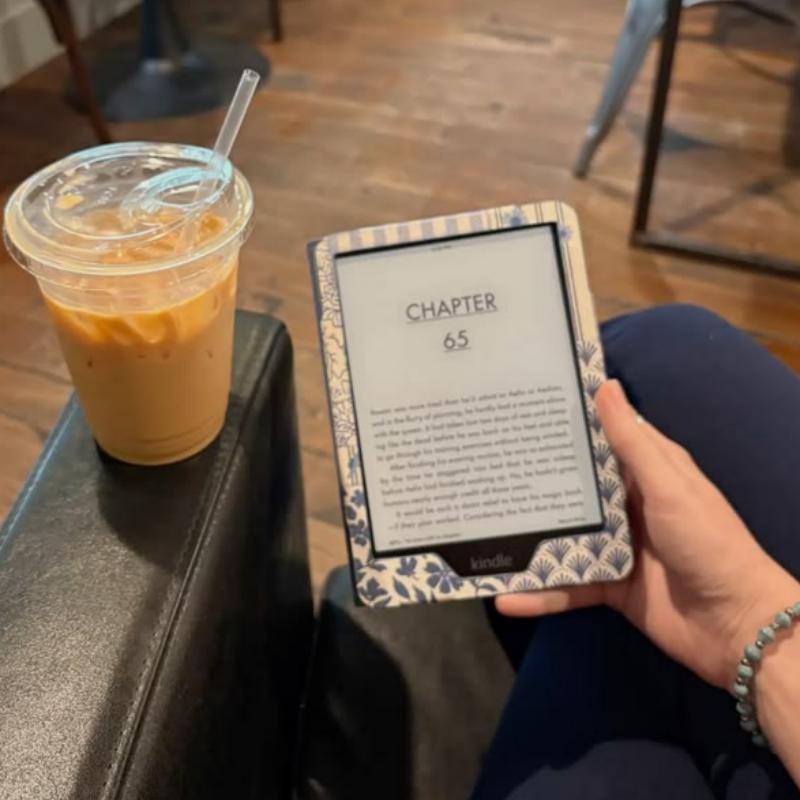
If you’re a writer, your Kindle probably isn’t just a place to read books.
It might be your research library, your source of inspiration, your way of procrastinating productively, or the device you reach for when you’re supposed to be writing but suddenly need to read “just one more chapter.”
I’ve definitely been there.
Writers tend to use books a little differently. We notice sentence structure. We save interesting phrases. We underline descriptions. We look up how another author handled a difficult scene. We read books in our genre to understand what’s working. Sometimes we’re reading for fun, and sometimes we’re technically “working.”
That makes the right Kindle setup surprisingly useful.
You don't need a giant collection of gadgets. A few well-chosen Kindle accessories can make it easier to read for long periods, keep your hands free while writing, and move between your manuscript and your reading material without constantly rearranging your desk.
Here are some Kindle accessories that make particular sense for writers and authors.
1. A Lightweight Kindle Case
Let's start with the obvious one: a Kindle case.
If you're a writer, there's a good chance your Kindle travels with you. It might live in your work bag, sit next to your laptop, or spend the afternoon at your favorite coffee shop.
A protective case is important, but I would pay attention to weight too.
When you're already carrying a laptop, notebook, water bottle, chargers, and approximately 12 pens you swear you're going to use, the last thing you need is an unnecessarily heavy Kindle.
A slim case keeps the device protected without making it feel bulky.
I'd also think about how the case works with other accessories.
For writers, a Kindle isn't always being used in the same position. Sometimes you're holding it on the couch. Sometimes it's sitting next to your laptop. Sometimes you're standing in the kitchen because apparently that's where your best plot ideas happen.
A case that can work with different accessories gives you a little more freedom.
A fully magnetic Kindle case is one option. The entire back can provide a flexible surface for compatible magnetic accessories, so you're not limited to one fixed attachment point.
GaNinno, for example, makes customizable fully magnetic Kindle cases that can be paired with magnetic grips and stands. The useful part isn't simply having a magnetic case. It's being able to change the setup depending on what you're doing.
For someone whose reading habits change throughout the day, that can be surprisingly practical.
2. A Kindle Grip for Long Reading Sessions
Writers read a lot.
Sometimes because we love books.
Sometimes because we're researching.
And sometimes because reading other people's work is the best possible way to avoid staring at a blank document.
Either way, long reading sessions can make your hands tired.
A Kindle grip gives you something more comfortable to hold, especially when you're reading one-handed.
This is useful when you're on the couch, sitting outside, waiting at an appointment, or lying in bed.
It can also help when you're holding the Kindle at an angle instead of directly in front of you.
A magnetic grip is particularly convenient if you're using a compatible magnetic Kindle case. You can adjust the grip depending on your hand position rather than being stuck with one location.
That's a small feature, but writers tend to spend a lot of time with their hands on devices.
Anything that makes that experience more comfortable is worth considering.
3. A Magnetic Kindle Stand for Your Writing Desk
If I had to pick one Kindle accessory specifically for writers, a stand would be near the top of the list.
The reason is simple: writers are constantly switching between reading and writing.
Maybe you're reading a reference book while working on a novel.
Maybe you're checking a craft book while editing.
Maybe you're researching historical details for a story.
Maybe you're reading another author's work while studying pacing or dialogue.
In all of these situations, having the Kindle upright is much easier than laying it flat on your desk.
You can place the Kindle beside your laptop and keep the book visible while you write.
It almost becomes a second screen.
A small magnetic Kindle stand can be particularly convenient because you can move your Kindle from handheld reading to desk reading without changing the case.
And when you're done writing, you can simply pick it up and move to the couch.
No complicated setup required.
4. A Kindle Setup for Research
Research is one of those things that can take over a writer's entire day.
You start researching one historical fact and three hours later you're reading about the clothing habits of people who lived 600 years ago.
Not that I've ever done that.
A Kindle can make research more organized because you can keep reference books, biographies, historical texts, writing guides, and other resources in one lightweight device.
A stand makes this even more useful.
Put your Kindle next to your computer, open the relevant chapter, and keep it visible while you work.
You can switch between your manuscript and your reference material without constantly picking up the Kindle.
For nonfiction research, I also recommend using highlights strategically.
Save passages that contain information you'll actually need later instead of highlighting entire pages.
Your future self will thank you.
5. A Notebook for Ideas That Appear at the Worst Possible Time
Every writer knows this phenomenon.
You are trying to sleep.
Or taking a shower.
Or driving.
Or brushing your teeth.
And suddenly you have the perfect line of dialogue.
Then you spend the next five minutes trying to convince yourself you'll remember it tomorrow.
You won't.
A small notebook can be one of the most useful “accessories” for a writer's Kindle setup.
Keep it beside your Kindle and use it for:
- Character ideas
- Interesting phrases
- Plot twists
- Research questions
- Book recommendations
- Writing prompts
- Quotes
- Random thoughts that might become something later
You can obviously use your phone for this, but there's something nice about keeping your reading and writing environment separate from social media notifications.
Sometimes the fewer distractions around you, the better.
6. A Reading Light for Late-Night Writing Sessions
Writers don't exactly have the most predictable schedules.
Sometimes you write in the morning.
Sometimes you're productive at 11 p.m.
Sometimes inspiration arrives precisely when you're supposed to be sleeping.
If you also like reading before bed, a small reading light can be useful.
Kindle's built-in front lighting already makes reading in low light easier, but an external light can help if you're also writing notes in a physical notebook.
Choose something adjustable and relatively soft.
You don't need your bedroom to look like a photography studio.
The goal is simply to create enough light to comfortably read and write without lighting up the entire room.
7. A Kindle Sleeve for Writers on the Go

If your Kindle travels with you, a sleeve is worth considering even if you already have a case.
A sleeve adds another layer of protection when your Kindle is inside a crowded bag.
This is particularly useful if you take your Kindle to:
- Coffee shops
- Libraries
- Writing groups
- Bookstores
- Coworking spaces
- Airports
- Hotels
- Classes
- Conferences
A simple padded sleeve is enough.
I prefer something lightweight that doesn't take up half my bag.
You can also use a small pouch to keep your Kindle accessories together. Put your charging cable, grip, and other small items in one place instead of letting them disappear into the bottom of your tote.
8. A Reliable Charging Cable
This is probably the least exciting accessory on the list.
It is also one you'll miss immediately when you need it.
If your Kindle is part of your everyday writing routine, keeping a charging cable at your main writing spot makes sense.
You might also keep a second one in your travel bag.
Writers often work in different places, and it’s nice not to have to remember to pack every little accessory before leaving the house.
Just make sure you choose the appropriate cable for your Kindle model.
9. A Portable Power Bank
A power bank isn't necessary for everyone, but it's useful if you write and read outside your home regularly.
Imagine spending the entire afternoon at a coffee shop writing, taking a break to read, and realizing your Kindle is almost out of battery.
Not ideal.
A compact power bank can give you some extra flexibility when you're away from an outlet.
This is especially useful for writers who travel frequently or attend writing conferences.
You probably won't need to charge your Kindle every day, but having a backup is one less thing to worry about.
10. A Comfortable Setup for Reading Other Writers
One of the best ways to improve as a writer is, unsurprisingly, to read.
A lot.
And not just books in your favorite genre.
Read outside your usual categories. Pay attention to different voices, structures, pacing, dialogue, descriptions, and narrative styles.
This is where a comfortable Kindle setup becomes more than a convenience.
You might spend an hour reading a novel specifically because you're studying how the author handles chapter endings.
You might reread a paragraph five times because the description is unusually effective.
You might highlight a piece of dialogue and come back to it later.
A comfortable grip makes long sessions easier, while a stand can help when you're comparing what you're reading with something you're writing.
The goal is to make close reading feel natural instead of physically tiring.
11. A Custom Kindle Case That Feels Like Yours
Writers spend a lot of time thinking about aesthetics.
We care about notebooks, fonts, desk setups, coffee mugs, bookshelves, stationery, and sometimes ridiculously specific shades of beige.
So why shouldn't your Kindle have a little personality too?
A customizable Kindle case can make your device feel more personal.
You could choose:
- Your favorite color
- A personal photograph
- Artwork
- A collage
- A simple pattern
- Something related to your favorite genre
- A design inspired by your current writing project
This is one area where a brand like GaNinno can fit naturally into a writer's setup.
Its customizable magnetic Kindle cases let you personalize the appearance while keeping the back compatible with magnetic accessories such as grips and stands.
That means you don't necessarily have to choose between a case that looks personal and one that works well with your desk setup.
Your Kindle can look like something that belongs to you while still being practical.
12. A Stand for Editing and Proofreading
Here's another situation where a Kindle stand can be useful.
Imagine you're editing a manuscript on your laptop and using your Kindle to read another book in your genre.
Having the Kindle upright means you can glance over without picking it up.
You can compare chapter structures, look at formatting, study dialogue, or simply read during breaks.
If you're working on a long writing session, that small reduction in movement can make your desk feel much more organized.
It also keeps your Kindle screen at a more consistent viewing angle.
And when you're done, you can move it somewhere else without changing your whole setup.
13. A Simple Kindle Setup for Writing at a Coffee Shop
Coffee shops are basically unofficial offices for writers.
If you like writing outside your home, keep your Kindle setup minimal.
I'd bring:
Kindle + lightweight case + grip + charging cable + laptop + notebook.
If you have room, a compact stand can be incredibly useful.
But don't bring every accessory you own.
The whole point of a portable writing setup is to keep things simple.
A magnetic Kindle case can work particularly well here because you can use the same case with different accessories depending on whether you're reading or writing.
Grip when you're relaxing.
Stand when you're working.
Case when you're traveling.
One device, slightly different setup.
How to Choose the Right Kindle Accessories as a Writer
You don't need to buy every Kindle accessory just because another writer has one.
Think about how you actually use your Kindle.
If you mostly read on the couch, start with a comfortable case and grip.
If you read at your writing desk, a stand will probably be more useful.
If you use your Kindle for research, a stand and notebook make a practical combination.
If you travel to coffee shops and libraries, prioritize portability.
If you read for hours at a time, focus on reducing hand fatigue.
If you care about your desk aesthetic, consider a customizable case.
And if you move between all of these situations, look for accessories that can work together rather than forcing you to build several completely separate setups.
That's one of the biggest advantages of a flexible magnetic setup.
The Perfect Kindle Setup Doesn't Need to Be Complicated
Writers already have enough things competing for their attention.
Your Kindle setup shouldn't become another project.
You don't need a perfect desk.
You don't need 15 accessories.
You don't need to spend hundreds of dollars creating a “writer aesthetic.”
Start with the basics.
A lightweight case protects your Kindle. A grip makes longer reading sessions more comfortable. A stand keeps your Kindle visible while you write. A notebook gives your random ideas somewhere to go. A sleeve makes traveling easier.
Then add things based on your actual habits.
For writers who like changing locations throughout the day, a fully magnetic Kindle case can be a particularly flexible foundation. You can attach a grip when you're reading in your hand and switch to a stand when you sit down at your desk.
That means your Kindle can adapt to your writing routine instead of the other way around.
Final Thoughts
The best Kindle accessories for writers aren't necessarily the ones with the most features.
They're the ones that make reading, researching, and writing feel a little easier.
A comfortable case lets you carry your Kindle everywhere. A grip makes long reading sessions less tiring. A stand turns your Kindle into a convenient second reading screen. A notebook catches those random ideas before they disappear.
And a personalized case can make your Kindle feel like part of your creative space rather than just another piece of technology.
For writers and authors, a Kindle can be much more than an e-reader. It can be a research library, a source of inspiration, a place to study other writers, and a quiet companion during those long stretches of staring at a blank page.
The best setup is simply the one that supports all of those roles without getting in your way.
Because at the end of the day, the accessory shouldn't be the thing you notice.
The book should be.